


What Is A Landscaping Answering Service?
At its core, an answering service for landscaping is exactly what it sounds like: a system that picks up your business line when you or your team can't, so a caller reaches a real response instead of a voicemail box. But for landscaping specifically, "answering the phone" is only the starting point. The service also needs to handle what happens after the call connects.
A landscaping call rarely follows a simple script. A caller might be asking about a one-time spring cleanup, a recurring mowing contract, a full hardscape redesign, or an emergency after a storm knocked down a tree limb across their driveway. Each of those needs different information captured, property size, service frequency, urgency, budget range, timeline, before a crew can even give an accurate quote, let alone book the job.
A landscaping answering service, done properly, typically handles:
- Instant call pickup, so callers never hit voicemail during business hours, after hours, or during your busiest seasonal weeks.
- Service-specific qualification, asking the right follow-up questions based on whether the caller wants mowing, design, hardscaping, or storm cleanup.
- Estimate scheduling, booking the appointment directly onto your calendar rather than just relaying a message for someone to call back.
- Urgency detection, flagging time-sensitive requests, like fallen trees or irrigation flooding, for immediate dispatch rather than treating every call the same.
- CRM and calendar sync, so every call becomes a structured lead record your team can act on without manual data entry.
The difference between a basic answering service and one built for landscaping is the difference between "someone took a message" and "an estimate is already on the calendar." That distinction is where the real value, and the real revenue, sits.
Learn what a landscaping answering service should do
Why Do Landscapers Miss Calls?
Landscaping consistently ranks among the highest missed-call trades in the home services industry, and it isn't by accident. A few factors compound to make this worse for landscaping crews than for almost any other field service business:
- The equipment is loud. Mowers, blowers, trimmers, and chainsaws make it physically impossible to hear a phone ring, let alone hold a conversation, while a crew is actively working. Even a phone in a pocket set to maximum volume gets drowned out on an active job site.
- Crews are hands-on and mobile. Unlike an office-based business where someone is always near a desk phone, landscaping work happens outdoors, across multiple properties, often with hands full of tools or materials. There's no natural moment to check a phone between tasks.
- Call volume spikes hard, seasonally. Spring cleanup, mulching season, and the first heat wave of summer can triple inbound call volume in a matter of days. A crew sized for average call volume gets buried the moment seasonal demand hits, and every unanswered call during that surge is a lead calling a competitor next.
- Storm and emergency calls arrive without warning. A wind event or a heavy storm can generate a wave of urgent calls, downed limbs, drainage issues, damaged irrigation, all at once, exactly when your team is already stretched managing the storm's aftermath on existing job sites.
- Owners are often doing sales and labor simultaneously. In smaller landscaping businesses, the person who'd normally answer the phone is often the same person running the crew, meaning there's no dedicated point of contact free to pick up during the workday at all.
Put together, these factors mean a landscaping business can easily lose a large share of its inbound calls to voicemail, and unlike a B2B sales call, a homeowner looking for a quote rarely leaves a message and waits. They call the next name on their search results instead. At a typical landscaping project value in the low thousands of dollars, even a handful of missed calls converting elsewhere adds up to real, recurring monthly revenue walking out the door.
See how much missed calls are costing you
This blog is just the start.
Unlock the power of Callveriq’s AI with a live demo.

Live Service Or AI Agent?
Once a landscaping business decides it needs help answering calls, the real decision comes down to what kind of answering service to use. There are three common approaches, and they perform very differently for a business trying to convert quote requests into booked estimates.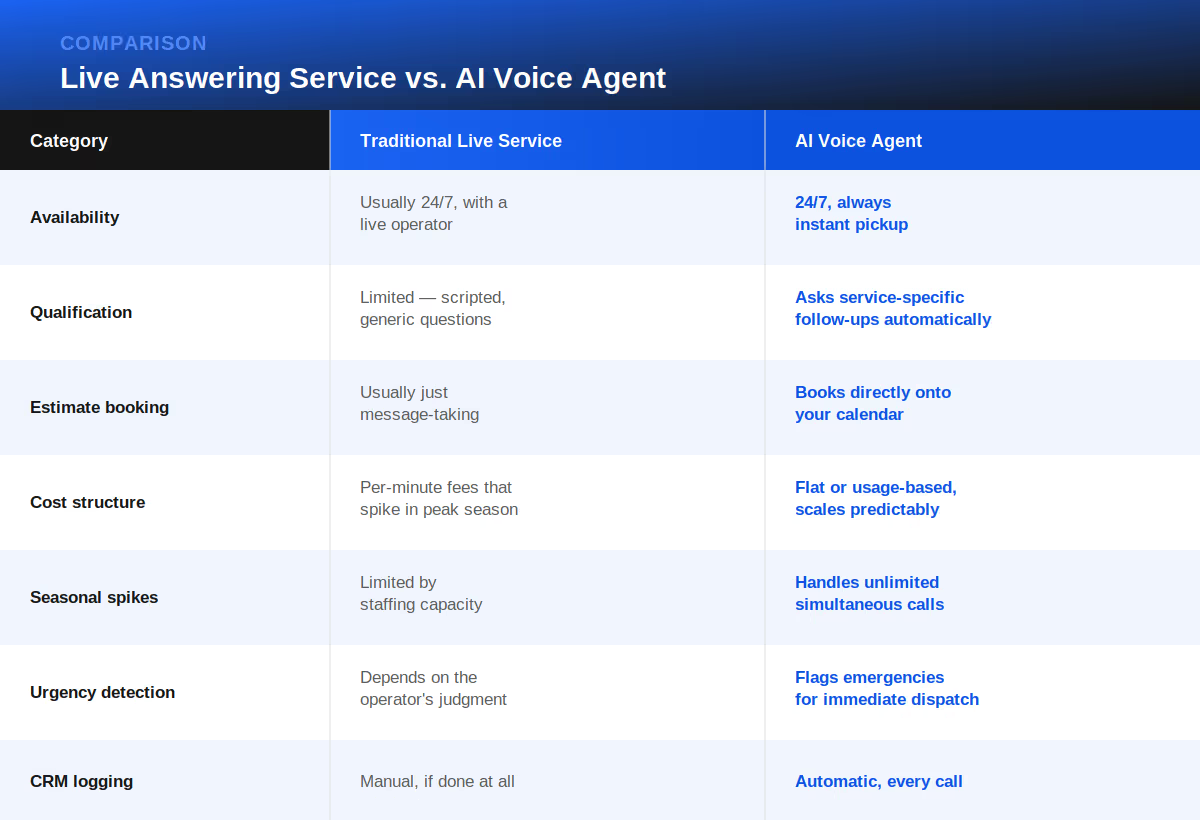
Live answering service vs AI voice agent comparison
Voicemail is effectively no system at all, most callers simply hang up and call the next business. A traditional live answering service improves on that by having a real person pick up, but that person is typically working from a generic script, not one built around the specific questions a landscaping quote actually requires. They can take a message competently; they usually can't tell the difference between a mowing inquiry and a hardscape redesign, or recognize that "there's a tree on my driveway" needs to jump the queue.
An AI voice agent closes both gaps at once. It answers instantly regardless of call volume, so a seasonal surge that would overwhelm a live service doesn't cause a single missed call, and it's built to ask the specific questions a landscaping quote depends on, then put the appointment directly on the calendar. Callveriq's overview of AI automation for home services shows what this looks like in practice for trades with the same seasonal, field-based call patterns as landscaping: emergency calls get routed immediately, standard quote requests get qualified and scheduled automatically, and every call outcome is logged without anyone touching a keyboard.
For a business where per-minute answering service fees spike exactly when call volume is highest, the worst possible time for costs to climb, an AI agent's flat or predictable pricing also tends to hold up better through a full landscaping season than a traditional live service billed by the minute.
Compare live answering vs AI agents
What Should You Look For?
Not every answering service, live or AI, is built with landscaping's specific call patterns in mind. Before choosing one, a few features make the difference between a service that just answers calls and one that actually books estimates:
- Seasonal scalability. The service should handle a tripled call volume during spring rush or post-storm cleanup exactly as well as it handles a quiet Tuesday in November, with no added wait time or dropped calls.
- Service-type qualification. It should be able to distinguish between a one-time cleanup, a recurring maintenance contract, and a full design project, and ask the right follow-up questions for each rather than using one generic script.
- Urgency and emergency detection. A downed tree or a flooded yard shouldn't wait in the same queue as a routine mowing quote, the service should recognize urgency and flag it for immediate action.
- Direct calendar booking, not just message-taking. The goal is an estimate on your schedule, not a callback task added to your to-do list.
- CRM and scheduling integration, so every call becomes a structured record your team can see and act on without manual re-entry.
- Transparent, predictable pricing that doesn't spike during your busiest, and most valuable, weeks of the year.
- A real transcript or summary of every call, so you can verify quality and confirm nothing important got missed, even on calls you weren't personally part of.
The businesses that get real ROI from an answering service are the ones that treat it as a qualification and booking tool, not just a way to avoid voicemail. Callveriq's piece on reducing missed calls and capturing inquiries for roofing businesses, another trade with sharp seasonal and weather-driven call spikes, covers the same underlying principle: automated routing and instant, AI-powered availability consistently convert more inquiries than routing calls to a person who may or may not be free.
Check the features that matter most
What Does It Actually Cost?
Pricing for landscaping answering services varies significantly depending on the type of service and how it's billed, and this is often where the real difference between options shows up, not just in the sticker price, but in how costs behave during your busiest season.
Traditional live answering services commonly charge a base monthly fee plus per-minute or per-call charges. That structure works fine in a slow month, but it means your costs climb fastest during exactly the weeks, spring rush, storm cleanup, holiday lighting season, when call volume, and therefore potential revenue, is highest. A landscaping business can end up paying the most for its answering service during the same weeks it's trying to convert the most estimates.
Voicemail and no system at all looks free on paper, but the real cost shows up as lost leads. If even a modest share of missed calls would have converted into a booked job, the monthly value walking out the door in missed revenue routinely exceeds what any answering service would have cost, often by a wide margin, especially at typical landscaping project values.
AI voice agents are typically priced on a flat monthly rate or a usage-based structure that scales more predictably with call volume, without the same per-minute penalty during peak season. Because the AI handles unlimited simultaneous calls without needing additional staffing, cost tends to stay far more stable even when your call volume triples during a seasonal surge.
The real math to run isn't "what does the service cost per month" in isolation, it's "what does one additional booked estimate need to be worth" to make the service pay for itself. For most landscaping businesses, converting even one or two additional quote requests a month into booked jobs covers the cost of an AI-powered answering service many times over.
See landscaping-specific pricing
How Do You Get Started?
Getting a landscaping answering service running doesn't require overhauling your existing phone number or workflow. Most businesses can get set up in a few practical steps:
- Keep your existing number, most services route through your current business line rather than requiring a new one.
- Define your service types and qualifying questions, what does your team need to know about a mowing request versus a hardships inquiry versus a storm emergency?
- Set your booking rules, which requests should go straight onto the calendar, and which need a callback from a specific crew lead or estimator?
- Connect your CRM and calendar, so every call becomes a structured, trackable lead the moment it ends.
- Test with real seasonal scenarios, run through a spring rush call, a routine maintenance inquiry, and an emergency storm call to confirm the service handles each correctly before your busy season hits.
Most landscaping businesses see the clearest results by launching before a seasonal spike, spring cleanup or storm season, rather than mid-surge, so the system is already tuned and proven before call volume peaks.
Start setting up your answering service
Key Takeaway
For a landscaping business, a missed call isn't a minor inconvenience, it's a quote request, often worth thousands of dollars, going straight to a competitor who happened to answer. The loud equipment, mobile crews, and sharp seasonal spikes that make landscaping so hard to staff for a phone line are exactly what make an answering service worth the investment. The real decision isn't whether to get one, it's choosing a service built to actually qualify a landscaping-specific request and book the estimate, rather than one that just takes a message and hopes someone calls back in time. Get that right, and every ringing phone becomes a scheduled estimate instead of a missed opportunity.
FAQs
1. Will an answering service work with my existing business phone number?
Yes, most landscaping answering services, including AI voice agents, route through your current number rather than requiring a new one.
2. Can it handle emergency calls differently from routine quote requests?
Yes, a well-built service detects urgent language (storm damage, flooding, downed trees) and routes those calls for immediate attention instead of standard scheduling.
3. How does pricing usually compare between live services and AI agents during peak season?
Live services often charge per-minute fees that rise sharply during high call volume; AI agents typically use flatter, more predictable pricing that scales with less cost penalty.
4. Do I need a large crew or office staff to use an AI answering service?
No, it's built specifically for small and mid-sized landscaping businesses that don't have a dedicated person available to answer every call.
5. How long does it take to get a landscaping answering service up and running?
Most setups take a few days to a couple of weeks, depending on how much customization your qualifying questions and booking rules require.